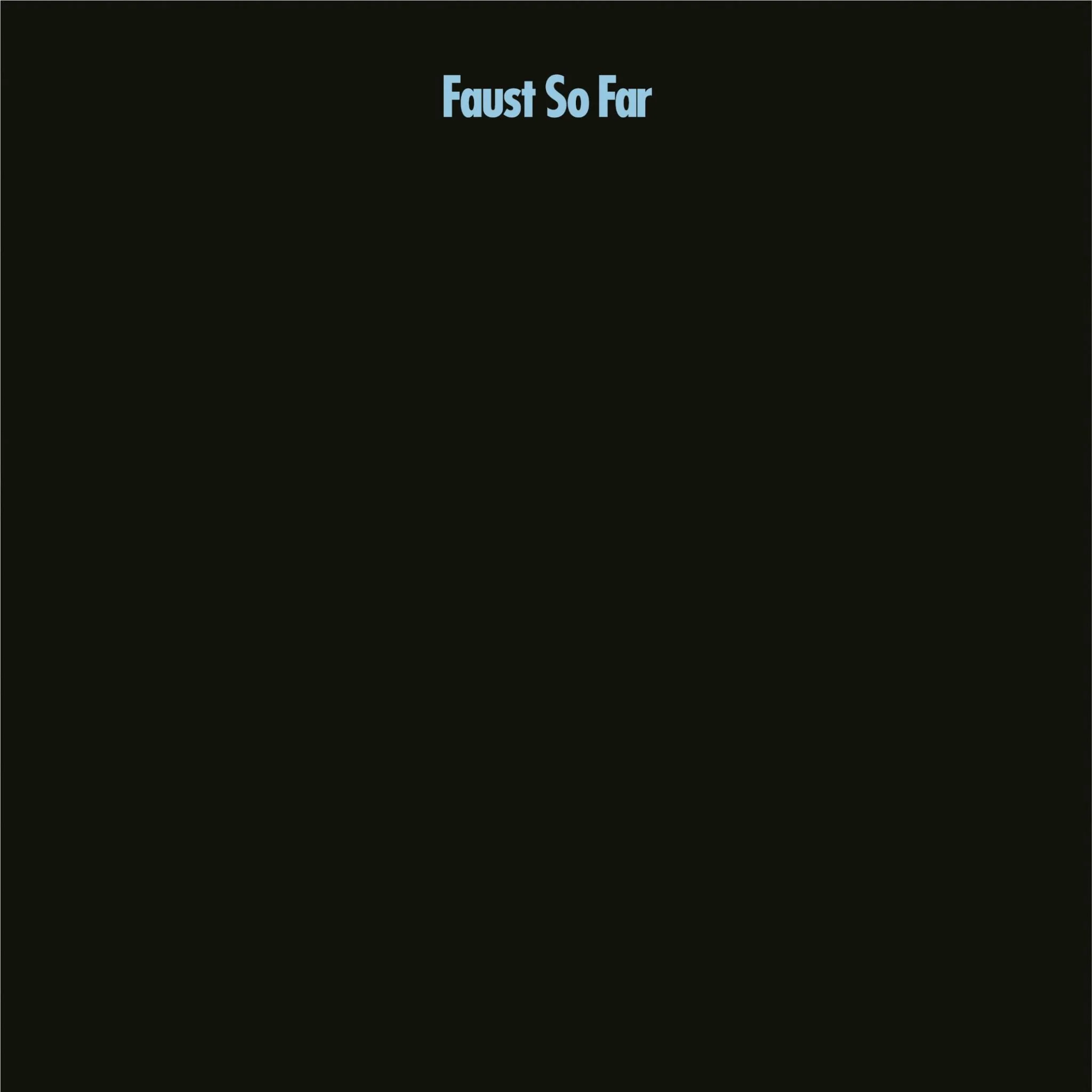
So Far
‘So Far’, so far out. By 1972, Faust had already dismantled the concept of a rock album. With their self-titled
debut, they tore through convention with tape edits, abstract structures, and a scathing collage of cultural
detritus. Its successor, recorded just six months later, was not a retreat from that radicalism, but its evolution.
Instead of challenging form through outright fragmentation, the band now disguised their subversion in
structures that almost, almost, resemble songs. But don’t be fooled. This is still Faust: unpredictable,
subversive, and unbound by convention.
The circumstances surrounding the album’s creation were no less unconventional than those of their debut. Faust
were still ensconced in the converted schoolhouse in Wümme, Lower Saxony, and its improvised studio - a riddle of cabling, tape and custom electronics. By this point, the band had grown more cohesive as a unit but remained
steadfastly anti-commercial, despite the pleas of their label.
“It’s A Rainy Day Sunshine Girl” sets the tone, sixteen bars of primal percussion exploding into a relentless rhythmic mantra, somewhere between a ritual and a rave-up. Sosna’s deadpan vocals and skeletal guitar, Diermaier’s thudding pulse, and Peron’s circular bassline create a mood both hypnotic and unsettling, on a track which feels as if it was beamed in from both the Velvet Underground’s New York loft and the outer edges of the Zodiak Free Arts Lab.
The song’s descent into a howling maelstrom of Irmler’s droning organ and Wüsthoff’s screaming sax captures
Faust’s unique balance of chaos and clarity. Through its taut two and a half minutes of folky finger picking and icy
electronics, “On the Way to Abamäe” oscillates between pastoral prettiness and gloomy paranoia while “No Harm” sets a new standard for tone shift. Muted horns and swaying syncopation, gradually joined by bass and organ, build into a pensive wave of orchestral heft, cresting into a bruised and bluesy vision of tender Germanicana, which is quickly cast aside in favour all out freak-funk. It’s the kind of acid overload which would leave today’s microdosers a quivering wreck, but in the hands of Faust finds the sweet-spot of spectral joy, where mind expanding magic never quite takes you to the point of madness.
The madness soon comes, taking the form of the overlapped, unhinged and tape-chewed slide guitar which
introduces the irresistible psych groove of the title track. Driven by the syncopated repetition of a jazzy rhythm
section, punctuated by staccato horns, and topped with all kinds of swirling, swooning electronics and vox, “So Far” is arguably the most catchy moment in the Faust Oeuvre. “Mamie Is Blue” pivots sharply into proto-industrial terrain, prefiguring post-punk’s darkest urges by nearly a decade, while “I’ve Got My Car and My TV” is pure Dada, with radio static, voice fragments, and machine-like repetition coalescing into a media-age mantra of alienation. Brief and
baffling interludes “Picnic On A Frozen River” and “Me Lack Space” dial up the disorientation before “Put On Your Socks” closes out the set with a foray into swing and ragtime, refracted through that particularly Faustian prism.
Taken as a whole, ‘So Far’ is less a linear progression from Faust’s debut than a sideways leap into a parallel sonic
dimension. Where the first album exploded rock from the inside out, ‘So Far’ rearranges the wreckage into strange
new shapes. There’s a sly humour here too, buried under the fuzz and tape edits, a knowing wink that these sonic
detours aren’t acts of nihilism, but of creation. Faust were building something. What, exactly, remains elusive, and
still utterly intoxicating.
Original: $21.42
-70%$21.42
$6.43Product Information
Product Information
Shipping & Returns
Shipping & Returns
Description
‘So Far’, so far out. By 1972, Faust had already dismantled the concept of a rock album. With their self-titled
debut, they tore through convention with tape edits, abstract structures, and a scathing collage of cultural
detritus. Its successor, recorded just six months later, was not a retreat from that radicalism, but its evolution.
Instead of challenging form through outright fragmentation, the band now disguised their subversion in
structures that almost, almost, resemble songs. But don’t be fooled. This is still Faust: unpredictable,
subversive, and unbound by convention.
The circumstances surrounding the album’s creation were no less unconventional than those of their debut. Faust
were still ensconced in the converted schoolhouse in Wümme, Lower Saxony, and its improvised studio - a riddle of cabling, tape and custom electronics. By this point, the band had grown more cohesive as a unit but remained
steadfastly anti-commercial, despite the pleas of their label.
“It’s A Rainy Day Sunshine Girl” sets the tone, sixteen bars of primal percussion exploding into a relentless rhythmic mantra, somewhere between a ritual and a rave-up. Sosna’s deadpan vocals and skeletal guitar, Diermaier’s thudding pulse, and Peron’s circular bassline create a mood both hypnotic and unsettling, on a track which feels as if it was beamed in from both the Velvet Underground’s New York loft and the outer edges of the Zodiak Free Arts Lab.
The song’s descent into a howling maelstrom of Irmler’s droning organ and Wüsthoff’s screaming sax captures
Faust’s unique balance of chaos and clarity. Through its taut two and a half minutes of folky finger picking and icy
electronics, “On the Way to Abamäe” oscillates between pastoral prettiness and gloomy paranoia while “No Harm” sets a new standard for tone shift. Muted horns and swaying syncopation, gradually joined by bass and organ, build into a pensive wave of orchestral heft, cresting into a bruised and bluesy vision of tender Germanicana, which is quickly cast aside in favour all out freak-funk. It’s the kind of acid overload which would leave today’s microdosers a quivering wreck, but in the hands of Faust finds the sweet-spot of spectral joy, where mind expanding magic never quite takes you to the point of madness.
The madness soon comes, taking the form of the overlapped, unhinged and tape-chewed slide guitar which
introduces the irresistible psych groove of the title track. Driven by the syncopated repetition of a jazzy rhythm
section, punctuated by staccato horns, and topped with all kinds of swirling, swooning electronics and vox, “So Far” is arguably the most catchy moment in the Faust Oeuvre. “Mamie Is Blue” pivots sharply into proto-industrial terrain, prefiguring post-punk’s darkest urges by nearly a decade, while “I’ve Got My Car and My TV” is pure Dada, with radio static, voice fragments, and machine-like repetition coalescing into a media-age mantra of alienation. Brief and
baffling interludes “Picnic On A Frozen River” and “Me Lack Space” dial up the disorientation before “Put On Your Socks” closes out the set with a foray into swing and ragtime, refracted through that particularly Faustian prism.
Taken as a whole, ‘So Far’ is less a linear progression from Faust’s debut than a sideways leap into a parallel sonic
dimension. Where the first album exploded rock from the inside out, ‘So Far’ rearranges the wreckage into strange
new shapes. There’s a sly humour here too, buried under the fuzz and tape edits, a knowing wink that these sonic
detours aren’t acts of nihilism, but of creation. Faust were building something. What, exactly, remains elusive, and
still utterly intoxicating.