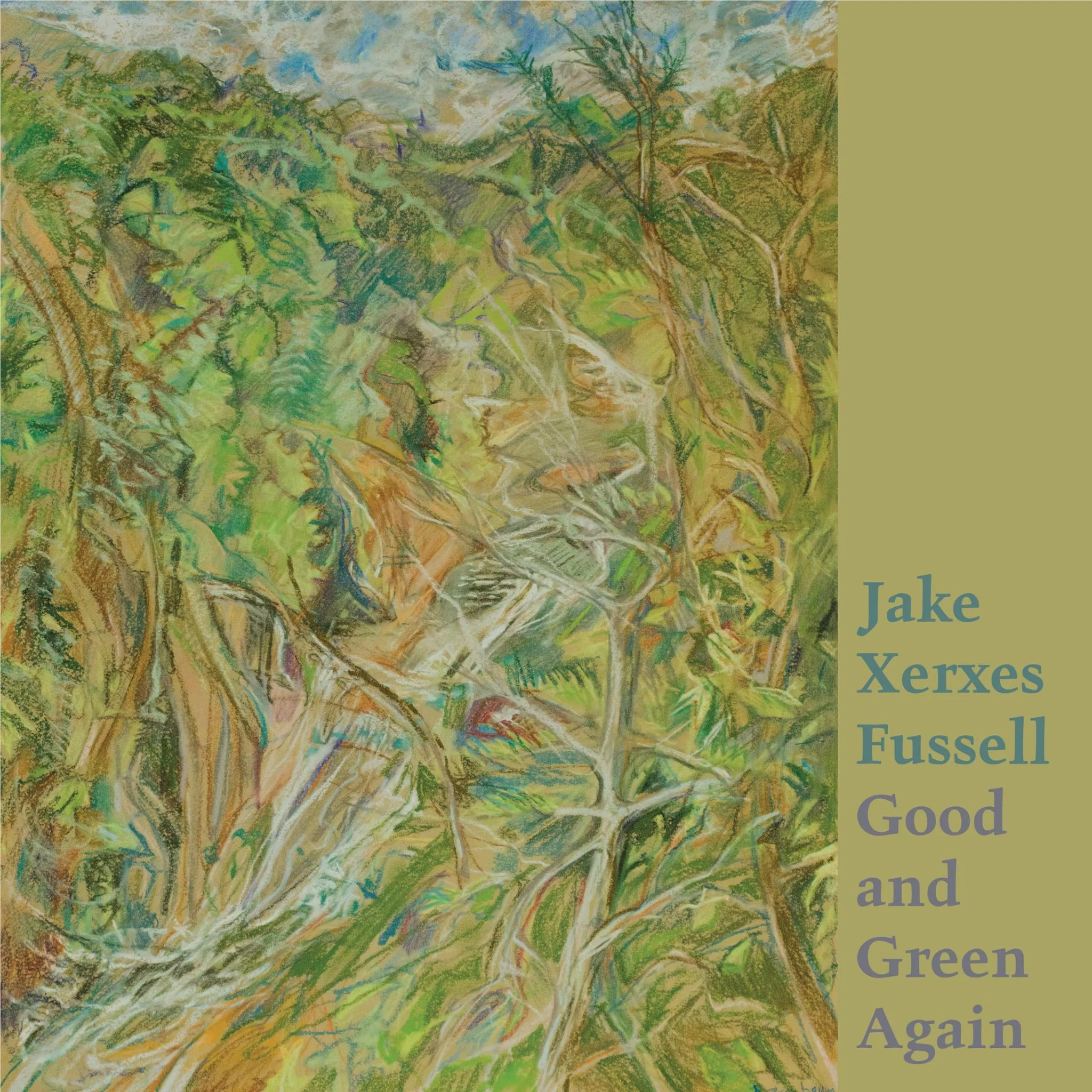
Good And Green Again
If I had a breast of glass
Wherein you might behold
Your name in secret I would write
In letters of bright gold
In bright gold One of the most striking and strangely moving moments on Jake Xerxes Fussell’s gorgeous Good and Green Again—an album, his fourth and most recent, replete with such dazzling moments—arrives at its very end, with the brief words to the final song “Washington.”
“General Washington/Noblest of men/His house, his horse, his cherry tree, and him,” Fussell sings, after a hushed introductory passage in which his trademark percussively fingerpicked Telecaster converses lacily with James Elkington’s parlor piano. That’s the entire lyrical content of the song, which proceeds to float away on orchestral clouds of French horn, trumpet, and strings, until it simply stops, suddenly evaporating, vanishing with no fade or trace, no resolution to its sorrowful minor-key chord progression, just silence and stillness and stark presidential absence. It feels like the end of a film, or the cold departure of a ghost, and is unlike anything else Jake has recorded.
The song provides an apt metaphor for the record as a whole and for Fussell’s artistic process itself. He appropriated the text from an early 20th century hooked rug by an anonymous Virginian artist depicting exactly what its red-stitched all-caps headline text and caption declares: Mount Vernon, a horse, a cherry tree, and the big man himself, cartoonishly grimacing (or is it wryly grinning? there’s not much mouth, just a red-thread wrinkle). George sits cross-legged in foppish leggings and slippers on a blue bestarred chair, with a perfect arch of snow-white wig haloed around his noble head. The rendering of this folk-art artifact ignores perspective and punctuation: every object in the lineup is the same size, and the list of the General’s stuff includes no commas or line breaks, a kind of accidental concrete poem that democratizes the supposedly great democratizer, reducing him to the same prosaic level as his diminutive crib, his prancing pony, and his tart cherries (maybe he is grimacing after all). The image may have been intended as a tribute, maybe even a reverent one—if we forget the fact that it’s a rug, and that we’re meant to walk all over it—but it hits as satire in its contemporary context, like a textile version of one of those all-caps cat caption memes. (I CAN HAZ CHERRIES?) The “noblest of men” looks a bit pathetic here, a little childish with his big-boy toys, a little goofy and alone—a little like how the rest of us often feel.
(Now, Jake is certainly no apologist for George Washington, nor for the myriad atrocities of American history, but he recognizes the deep wells of American song are filled from headwaters both fresh and vile. Within its ambiguities, “Washington” is, for Fussell, a placid protest song that elevates an artist and her rug above a general in his splendor. It’s a fragment of the broken ways we speak about history and power, a satirical shard sent to pierce and deflate our pernicious, endlessly regurgitated national mythologies. As such, it’s a deeply sad song. It’s not the only one here.)
Fussell carefully considers such contradictions in his studious choice of songs. He’s distinguished himself as one of his generation’s preeminent interpreters of traditional (and not so traditional) “folk” songs, a practice which he approaches with a refreshingly unfussy lack of nostalgia and preciousness, utterly devoid of folkie cosplay. By recontextualizing ancient vernacular songs and sources of the American South, he allows them to breathe and speak for themselves and for himself; he alternately inhabits them and allows them to inhabit him. His mesmerizing performances reveal the beauty of calling things by their true names, of coaxing old texts and recordings gently through the telescope of time, thereby transmuting them, through his own ineffable alchemy, into something approachably intimate and immediately relevant, something both his and ours.
In all his work Jake humanizes his material with his own profound curatorial and interpretive gifts, unmooring stories and melodies from their specific eras and origins and setting them adrift in our own waterways. The robust burr of hisMvoice, which periodically meltsM and catches at a particularly tender turn of phrase, and the swung rhythmic undertow of exquisite, seemingly effortless guitar-playing— here he plays more acoustic than ever before—pull new valences of meaning from ostensibly antique songs and subjects. What’s different about “Washington” is that it’s one of four original compositions on the album—the others are the three instrumentals—a career first for Fussell, who has heretofore been content to remain a vitreous vessel for existing, often anonymous, songs.
On Good and Green Again, Jake not only ventures beyond his established mastery of songcatching and songmaking into songwriting, but likewise navigates fresh sonic and compositional landscapes, going green with lusher, more atmospheric and ambitious arrangements. The result is the most conceptually focused, breathtakingly rendered, and enigmatically poignant record of his wondrous catalog. It’s also his most deliberately premeditated album, representing his fruitful return to a producer partnership after two
self-produced projects, What in the Natural World (2017) and Out of Sight (2019) (William Tyler produced his friend’s self-titled 2015 debut.) This time James Elkington produced and played a panoply of instruments, bringing to Jake’s arcane song choices his own peerless sense of harmony and orchestration, balance and dramatic tension, honed from collaborations with artists such as Michael
Chapman, Steve Gunn, Joan Shelley, Richard Thompson, and Jeff Tweedy. Jake knew after a 2018 Midwestern tour together that he wanted to work with Jim, appreciating his open ears, unorthodox influences, and flexibility in following instincts.
The pair enlisted a group of formidable players hailing from Durham, North Carolina (where Fussell lives) and elsewhere, including regular bandmembers Casey Toll (Mt. Moriah, Nathan Bowles) on upright bass, Libby Rodenbough (Mipso) on strings, and Nathan Golub on pedal steel. They were joined by welcome newcomers Joe Westerlund (Megafaun, Califone) on drums, Joseph Decosimo on fiddle, Anna Jacobson on brass, and veteran collaborator and avowed Fussell fan Bonnie “Prince” Billy, who contributes additional vocals.
Together this crew is uncannily able to pinpoint that magical place on Jake’s musical map where melancholy, quietude, and head-nodding, foot-stomping joy commingle and transcend—places like, on previous albums, “Raggy Levy,” “Jump for Joy,” and “The River St. Johns.” Album opener “Love Farewell” (featuring some beautiful singing by Bonnie “Prince” Billy) rings that bell with an elliptical tale of the folly of war, set to the world’s most heartbreaking goodbye march for a lover left behind. “Carriebelle” and “Breast of Glass” each similarly concerns, in its own way, romantic love and leavings. All three songs highlight Jacobson’s diaphanous, understated brass parts, tying them together in a true lover’s knot. “Rolling Mills Are Burning Down,” with its distant keening strings and capacious sense of space, observes and mourns the loss of work and community in the wake of elemental disaster. Nine-minute tour de force “The Golden Willow Tree,” the sole explicitly narrative song herein, is a hypnotic, minimalist rendering of a tragic maritime ballad about scuttling an enemy ship in exchange for wealth and glory—and a captain’s inevitable betrayal. It’s a rejoinder to “Love Farewell”’s naïve cheer in the face of imminent violence.
If overall Good and Green Again sounds a little sadder and slower than Fussell’s past records, well, maybe we’re all a little sadder and slower these days. A smoldering mood of regret and loss pervades, a distinct vibe of vanitas. But three airy instrumentals, all Fussell originals—“Frolic,” “What Did the Hen Duck Say to the Drake?,” and “In Florida”—punctuate the program, offering respite and light in the form of crisp, shuffling play-party tunes, each in turn somewhat more hopeful and exuberant than the last. Their resemblance to lullabies is, perhaps, not coincidental. Fussell and his partner welcomed their first child into the world during the making of Good and Green Again. These lovely songs bear that promise in letters of bright gold.
Cannons roar, drums a-beating Oh my love, there’s no retreating
Original: $16.07
-70%$16.07
$4.82Product Information
Product Information
Shipping & Returns
Shipping & Returns
Description
If I had a breast of glass
Wherein you might behold
Your name in secret I would write
In letters of bright gold
In bright gold One of the most striking and strangely moving moments on Jake Xerxes Fussell’s gorgeous Good and Green Again—an album, his fourth and most recent, replete with such dazzling moments—arrives at its very end, with the brief words to the final song “Washington.”
“General Washington/Noblest of men/His house, his horse, his cherry tree, and him,” Fussell sings, after a hushed introductory passage in which his trademark percussively fingerpicked Telecaster converses lacily with James Elkington’s parlor piano. That’s the entire lyrical content of the song, which proceeds to float away on orchestral clouds of French horn, trumpet, and strings, until it simply stops, suddenly evaporating, vanishing with no fade or trace, no resolution to its sorrowful minor-key chord progression, just silence and stillness and stark presidential absence. It feels like the end of a film, or the cold departure of a ghost, and is unlike anything else Jake has recorded.
The song provides an apt metaphor for the record as a whole and for Fussell’s artistic process itself. He appropriated the text from an early 20th century hooked rug by an anonymous Virginian artist depicting exactly what its red-stitched all-caps headline text and caption declares: Mount Vernon, a horse, a cherry tree, and the big man himself, cartoonishly grimacing (or is it wryly grinning? there’s not much mouth, just a red-thread wrinkle). George sits cross-legged in foppish leggings and slippers on a blue bestarred chair, with a perfect arch of snow-white wig haloed around his noble head. The rendering of this folk-art artifact ignores perspective and punctuation: every object in the lineup is the same size, and the list of the General’s stuff includes no commas or line breaks, a kind of accidental concrete poem that democratizes the supposedly great democratizer, reducing him to the same prosaic level as his diminutive crib, his prancing pony, and his tart cherries (maybe he is grimacing after all). The image may have been intended as a tribute, maybe even a reverent one—if we forget the fact that it’s a rug, and that we’re meant to walk all over it—but it hits as satire in its contemporary context, like a textile version of one of those all-caps cat caption memes. (I CAN HAZ CHERRIES?) The “noblest of men” looks a bit pathetic here, a little childish with his big-boy toys, a little goofy and alone—a little like how the rest of us often feel.
(Now, Jake is certainly no apologist for George Washington, nor for the myriad atrocities of American history, but he recognizes the deep wells of American song are filled from headwaters both fresh and vile. Within its ambiguities, “Washington” is, for Fussell, a placid protest song that elevates an artist and her rug above a general in his splendor. It’s a fragment of the broken ways we speak about history and power, a satirical shard sent to pierce and deflate our pernicious, endlessly regurgitated national mythologies. As such, it’s a deeply sad song. It’s not the only one here.)
Fussell carefully considers such contradictions in his studious choice of songs. He’s distinguished himself as one of his generation’s preeminent interpreters of traditional (and not so traditional) “folk” songs, a practice which he approaches with a refreshingly unfussy lack of nostalgia and preciousness, utterly devoid of folkie cosplay. By recontextualizing ancient vernacular songs and sources of the American South, he allows them to breathe and speak for themselves and for himself; he alternately inhabits them and allows them to inhabit him. His mesmerizing performances reveal the beauty of calling things by their true names, of coaxing old texts and recordings gently through the telescope of time, thereby transmuting them, through his own ineffable alchemy, into something approachably intimate and immediately relevant, something both his and ours.
In all his work Jake humanizes his material with his own profound curatorial and interpretive gifts, unmooring stories and melodies from their specific eras and origins and setting them adrift in our own waterways. The robust burr of hisMvoice, which periodically meltsM and catches at a particularly tender turn of phrase, and the swung rhythmic undertow of exquisite, seemingly effortless guitar-playing— here he plays more acoustic than ever before—pull new valences of meaning from ostensibly antique songs and subjects. What’s different about “Washington” is that it’s one of four original compositions on the album—the others are the three instrumentals—a career first for Fussell, who has heretofore been content to remain a vitreous vessel for existing, often anonymous, songs.
On Good and Green Again, Jake not only ventures beyond his established mastery of songcatching and songmaking into songwriting, but likewise navigates fresh sonic and compositional landscapes, going green with lusher, more atmospheric and ambitious arrangements. The result is the most conceptually focused, breathtakingly rendered, and enigmatically poignant record of his wondrous catalog. It’s also his most deliberately premeditated album, representing his fruitful return to a producer partnership after two
self-produced projects, What in the Natural World (2017) and Out of Sight (2019) (William Tyler produced his friend’s self-titled 2015 debut.) This time James Elkington produced and played a panoply of instruments, bringing to Jake’s arcane song choices his own peerless sense of harmony and orchestration, balance and dramatic tension, honed from collaborations with artists such as Michael
Chapman, Steve Gunn, Joan Shelley, Richard Thompson, and Jeff Tweedy. Jake knew after a 2018 Midwestern tour together that he wanted to work with Jim, appreciating his open ears, unorthodox influences, and flexibility in following instincts.
The pair enlisted a group of formidable players hailing from Durham, North Carolina (where Fussell lives) and elsewhere, including regular bandmembers Casey Toll (Mt. Moriah, Nathan Bowles) on upright bass, Libby Rodenbough (Mipso) on strings, and Nathan Golub on pedal steel. They were joined by welcome newcomers Joe Westerlund (Megafaun, Califone) on drums, Joseph Decosimo on fiddle, Anna Jacobson on brass, and veteran collaborator and avowed Fussell fan Bonnie “Prince” Billy, who contributes additional vocals.
Together this crew is uncannily able to pinpoint that magical place on Jake’s musical map where melancholy, quietude, and head-nodding, foot-stomping joy commingle and transcend—places like, on previous albums, “Raggy Levy,” “Jump for Joy,” and “The River St. Johns.” Album opener “Love Farewell” (featuring some beautiful singing by Bonnie “Prince” Billy) rings that bell with an elliptical tale of the folly of war, set to the world’s most heartbreaking goodbye march for a lover left behind. “Carriebelle” and “Breast of Glass” each similarly concerns, in its own way, romantic love and leavings. All three songs highlight Jacobson’s diaphanous, understated brass parts, tying them together in a true lover’s knot. “Rolling Mills Are Burning Down,” with its distant keening strings and capacious sense of space, observes and mourns the loss of work and community in the wake of elemental disaster. Nine-minute tour de force “The Golden Willow Tree,” the sole explicitly narrative song herein, is a hypnotic, minimalist rendering of a tragic maritime ballad about scuttling an enemy ship in exchange for wealth and glory—and a captain’s inevitable betrayal. It’s a rejoinder to “Love Farewell”’s naïve cheer in the face of imminent violence.
If overall Good and Green Again sounds a little sadder and slower than Fussell’s past records, well, maybe we’re all a little sadder and slower these days. A smoldering mood of regret and loss pervades, a distinct vibe of vanitas. But three airy instrumentals, all Fussell originals—“Frolic,” “What Did the Hen Duck Say to the Drake?,” and “In Florida”—punctuate the program, offering respite and light in the form of crisp, shuffling play-party tunes, each in turn somewhat more hopeful and exuberant than the last. Their resemblance to lullabies is, perhaps, not coincidental. Fussell and his partner welcomed their first child into the world during the making of Good and Green Again. These lovely songs bear that promise in letters of bright gold.
Cannons roar, drums a-beating Oh my love, there’s no retreating