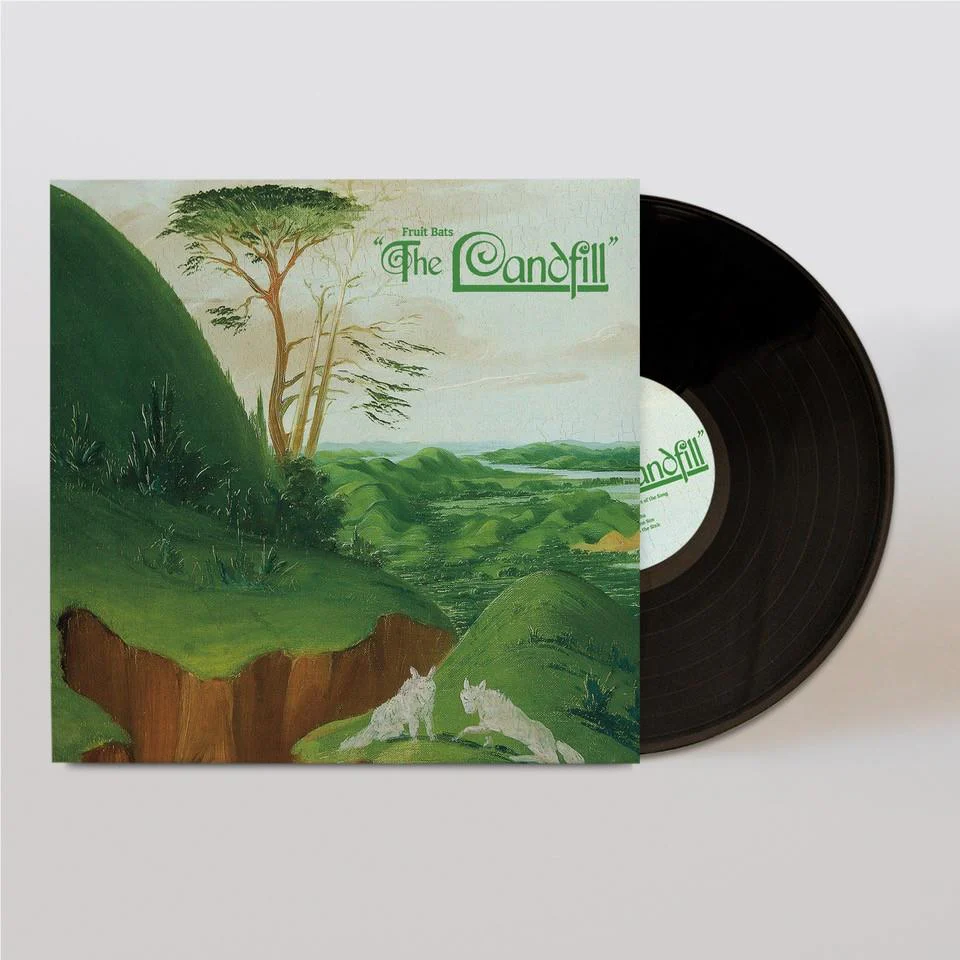
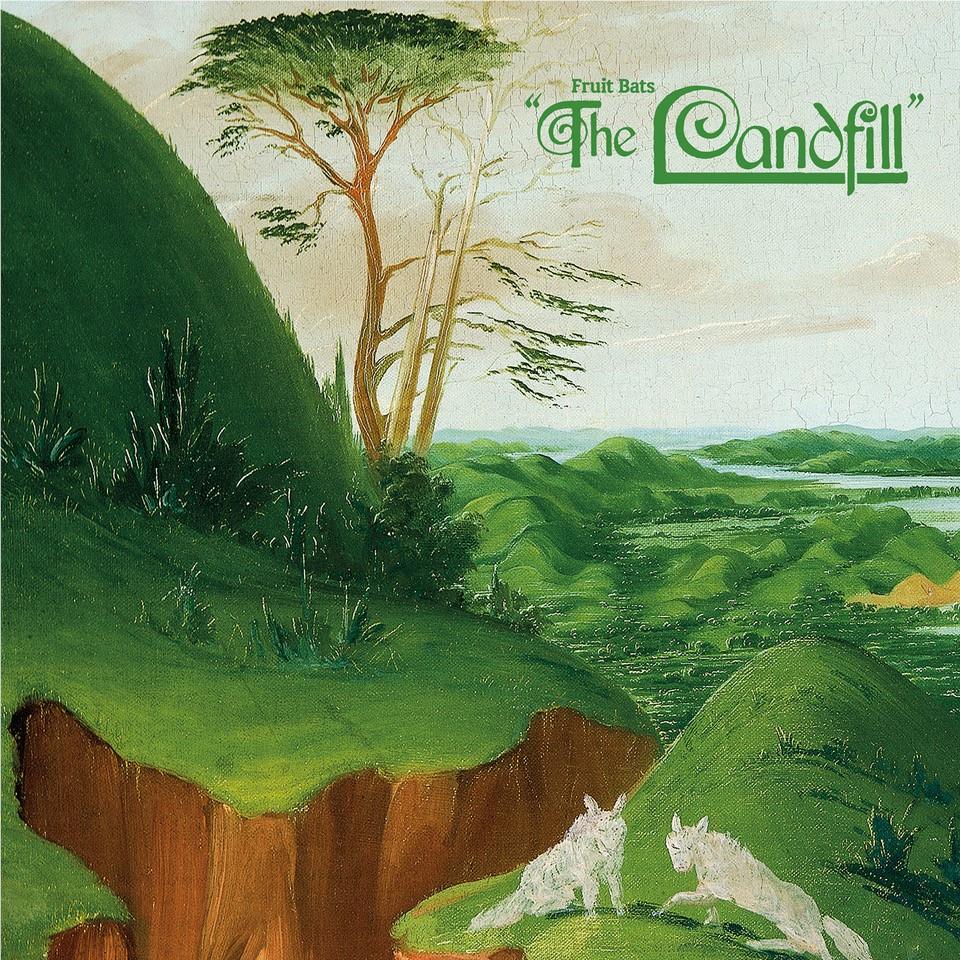
The Landfill (Vinyl)
The midwest, particularly the part of the midwest Eric D. Johnson hails from, is a largely flat expanse. Zipping through it on the highway, you’ll see cities and towns rise up in the distance, but blink and you’ll miss other man-made rejoinders to horizontal living dotting the landscape, hill after hill, built from the refuse of the past: landfills. Some of these hills make for great sledding spots, parks, and trails. Others turn organic waste into compost. The Landfill is something else entirely: a mountain dominating the landscape of Johnson’s heart.
Over the course of his now 25-year career under the Fruit Bats moniker, most of Eric D. Johnson’s output has been the product of patience and fine-tuning. His songs, to borrow a phrase, are slow growers, given life on albums that encompass long stretches of time and memory. Baby Man changed that — he disallowed himself from referring to material he’d been working on before laying the album down, utilizing the morning pages technique of stream-of-consciousness, observational songwriting which flowed directly into his afternoon recording sessions. It was both a breathtaking document of Johnson’s skill as a singersongwriter and an unvarnished account of the two weeks in which he recorded the album.
Baby Man’s closeness to Johnson’s heart and the close attention to his voice and instrument its minimalist-maximalist ethos required uncorked something in him as he wrote towards a new full band effort. “That session was over,” he explains, “but there was way more to explore. I liked the immediacy of it, and I wanted to see how that would translate into a full-band Fruit Bats record.” Within weeks, he was back in a studio, this time with his band — David Dawda (bass), Josh Mease (guitars, synth), Frank LoCrasto (piano, synth), and Kosta Galanopoulos (drums) — with whom Johnson has spent over a decade building Fruit Bats into one of the most in-demand live acts in indie rock. Listening to The Landfill, it’s not hard to understand why: simply put, this band smokes.
Producing the initial recording sessions in Washington’s Bear Creek Studios, Johnson set out to capture “the sound of this band I constantly marvel at, the feeling of being in a room with musicians you love and trust enough to let them cook.” They laid most of it down on the floor — no click tracks, no comped vocals, and minimal overdubs, with frequent collaborator Thom Monahan returning to provide additional production and The Landfill’s final mix. “It’s how we do things with my other band, Bonny Light Horseman, and I was curious to see how it would work with Fruit Bats,” Johnson notes. “It’s both a very personal record, and my most collaborative to date.”
It’s also the most live a Fruit Bats record has been since 2009’s The Ruminant Band, and in paring back the number of tracks that typically layer a full-band song, the psychedelic, technicolor dreaminess of their sound is more vivid than ever. Time and space melt into the sublime as the band gels around Johnson’s hazy croon on “That Goddamn Sun,” stretching out to accommodate him as he trips from California to North Carolina. In striking a balance between ecstatic romance and melancholia, “Think Aboutcha” occupies the blissful-butdoomed intersection of the E Street Band and Paul McCartney, playful but playing for stakes that are larger than life, while “Perhaps We’re a Storm” charges headlong into the unknown.
All of these songs — most of the songs on The Landfill, in fact — mark themselves immediately as some of the best in Eric D. Johnson’s ever-expanding songbook, seekers and anthems alike. It’s the most daunting peak he’s scaled yet, musically or lyrically: a swashbuckling set of full-band jammers couldn’t be more honest and open-hearted about his hopes and anxieties, his dreams and failures, what’s passed and what will come to pass, were it just him, his guitar, and the listener.
Original: $36.30
-70%$36.30
$10.89Product Information
Product Information
Shipping & Returns
Shipping & Returns
Description
The midwest, particularly the part of the midwest Eric D. Johnson hails from, is a largely flat expanse. Zipping through it on the highway, you’ll see cities and towns rise up in the distance, but blink and you’ll miss other man-made rejoinders to horizontal living dotting the landscape, hill after hill, built from the refuse of the past: landfills. Some of these hills make for great sledding spots, parks, and trails. Others turn organic waste into compost. The Landfill is something else entirely: a mountain dominating the landscape of Johnson’s heart.
Over the course of his now 25-year career under the Fruit Bats moniker, most of Eric D. Johnson’s output has been the product of patience and fine-tuning. His songs, to borrow a phrase, are slow growers, given life on albums that encompass long stretches of time and memory. Baby Man changed that — he disallowed himself from referring to material he’d been working on before laying the album down, utilizing the morning pages technique of stream-of-consciousness, observational songwriting which flowed directly into his afternoon recording sessions. It was both a breathtaking document of Johnson’s skill as a singersongwriter and an unvarnished account of the two weeks in which he recorded the album.
Baby Man’s closeness to Johnson’s heart and the close attention to his voice and instrument its minimalist-maximalist ethos required uncorked something in him as he wrote towards a new full band effort. “That session was over,” he explains, “but there was way more to explore. I liked the immediacy of it, and I wanted to see how that would translate into a full-band Fruit Bats record.” Within weeks, he was back in a studio, this time with his band — David Dawda (bass), Josh Mease (guitars, synth), Frank LoCrasto (piano, synth), and Kosta Galanopoulos (drums) — with whom Johnson has spent over a decade building Fruit Bats into one of the most in-demand live acts in indie rock. Listening to The Landfill, it’s not hard to understand why: simply put, this band smokes.
Producing the initial recording sessions in Washington’s Bear Creek Studios, Johnson set out to capture “the sound of this band I constantly marvel at, the feeling of being in a room with musicians you love and trust enough to let them cook.” They laid most of it down on the floor — no click tracks, no comped vocals, and minimal overdubs, with frequent collaborator Thom Monahan returning to provide additional production and The Landfill’s final mix. “It’s how we do things with my other band, Bonny Light Horseman, and I was curious to see how it would work with Fruit Bats,” Johnson notes. “It’s both a very personal record, and my most collaborative to date.”
It’s also the most live a Fruit Bats record has been since 2009’s The Ruminant Band, and in paring back the number of tracks that typically layer a full-band song, the psychedelic, technicolor dreaminess of their sound is more vivid than ever. Time and space melt into the sublime as the band gels around Johnson’s hazy croon on “That Goddamn Sun,” stretching out to accommodate him as he trips from California to North Carolina. In striking a balance between ecstatic romance and melancholia, “Think Aboutcha” occupies the blissful-butdoomed intersection of the E Street Band and Paul McCartney, playful but playing for stakes that are larger than life, while “Perhaps We’re a Storm” charges headlong into the unknown.
All of these songs — most of the songs on The Landfill, in fact — mark themselves immediately as some of the best in Eric D. Johnson’s ever-expanding songbook, seekers and anthems alike. It’s the most daunting peak he’s scaled yet, musically or lyrically: a swashbuckling set of full-band jammers couldn’t be more honest and open-hearted about his hopes and anxieties, his dreams and failures, what’s passed and what will come to pass, were it just him, his guitar, and the listener.